Chase the sun around your house
Drag the sun across the sky and watch the shadows swing. Which way a room faces decides what time of day it's nice to be in, and that's why kitchens face one way and bedrooms face another.
Orientation, how compass direction changes light through the day
Run a sun study on a house, then rearrange the rooms to suit it
There's a spot in your house that's lovely in the morning and useless by afternoon. There's another that's the reverse. And there's probably one room that's dark all day, no matter what you do to it.
None of that is about the room. It's about which way the windows point, and it's the same every single day of your life.
The sun does the same thing every day
Start with the one fact everything else follows from:
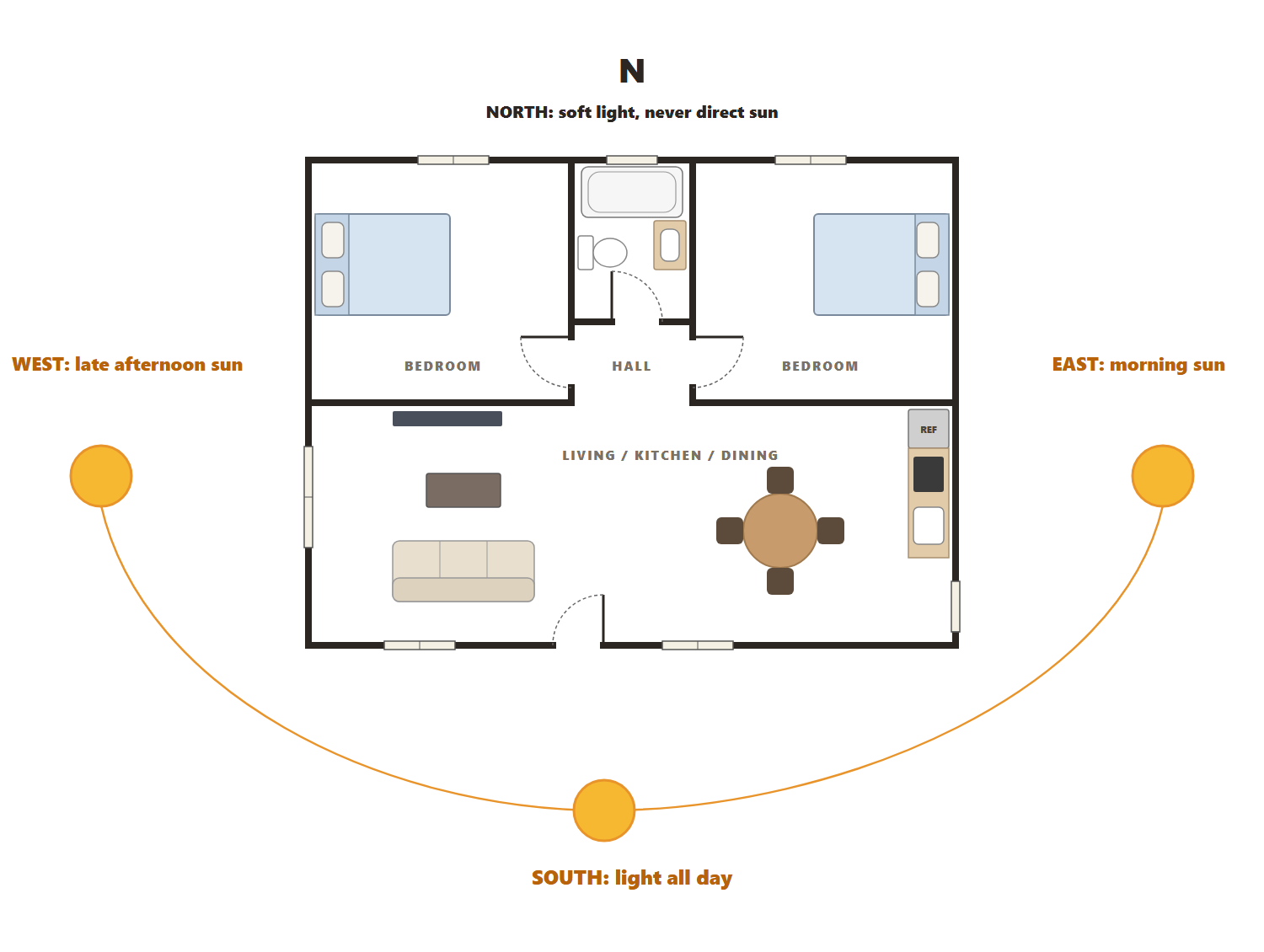
The sun rises in the east, crosses the southern sky, and sets in the west. Which way a room faces decides what time of day it is bright.
That's true everywhere in the northern hemisphere outside the tropics, which includes every state in the US. This lesson uses Georgia as its example: Atlanta sits at about 34° north, so all year round the sun crosses the southern sky. South of the tropics it crosses the northern sky instead and every rule below flips, and near the equator the sun is almost straight overhead at noon, so these rules matter much less.
So a window's direction decides its time of day:
- East-facing: direct sun in the morning, then nothing but soft light after midday. Bright early, cool later.
- South-facing: sun for most of the day, and the strongest light in the house. The most valuable direction there is.
- West-facing: nothing much in the morning, then strong low afternoon and evening sun. Warm, glary, and hard to shade because the sun is coming in almost level.
- North-facing: hardly any direct sun. On long summer days it can catch a little early in the morning and late in the evening. The rest of the time it's even, steady, shadowless light.
North isn't bad, by the way. A lot of artists like it, because it hardly changes and doesn't glare. It just doesn't do much to warm a room.
Which is how rooms get assigned
Here's the usual rule of thumb for where rooms go. It's advice, not law, and plenty of good houses break it:
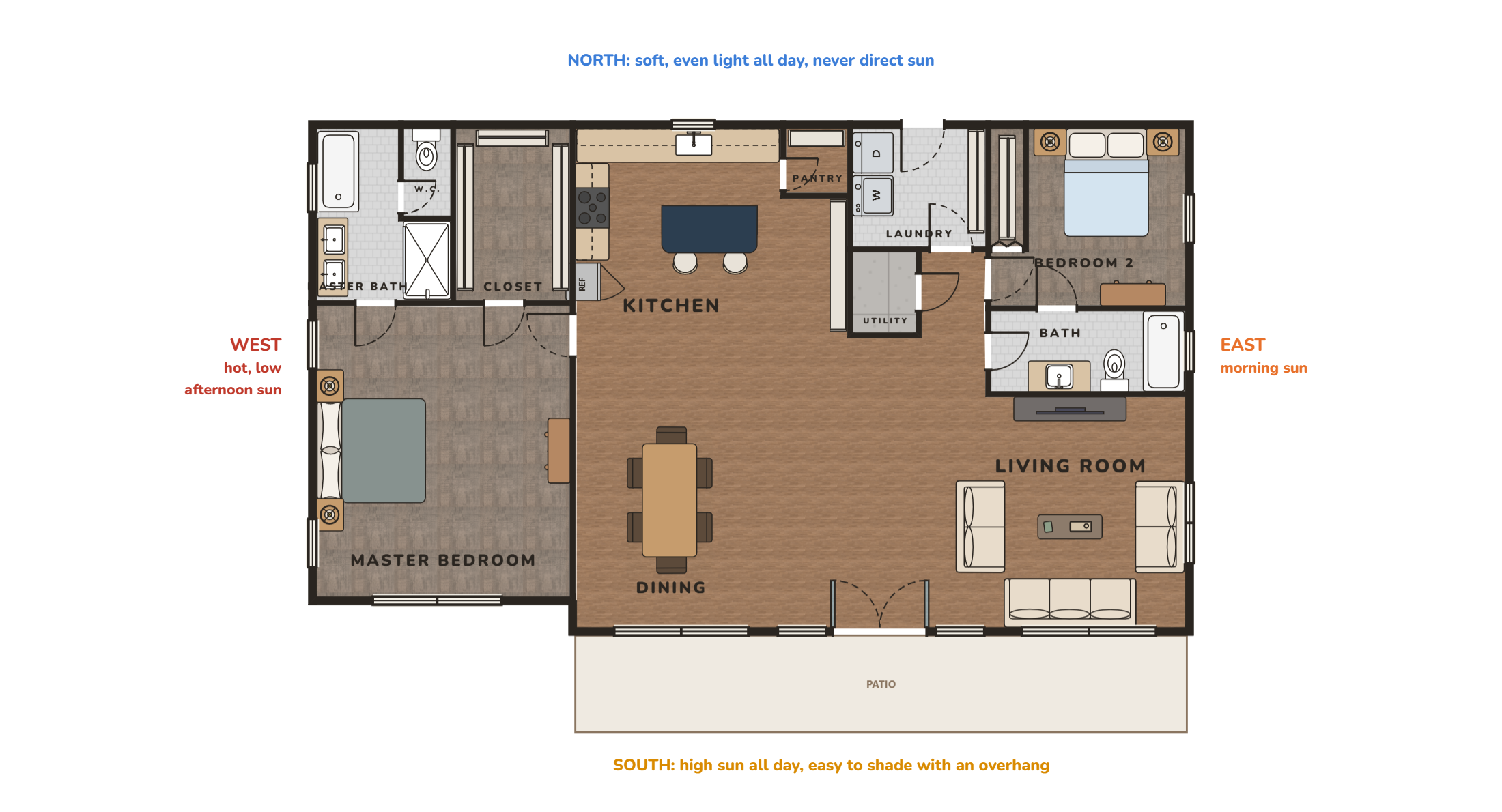
- Kitchen and breakfast: east. You're in there in the morning, and morning sun is cheerful and not yet hot.
- Living room: south or west. You're in there in the afternoon and evening. West gets you sunset out of the window.
- Bedrooms: east or north. East if you like waking with the light; north if you don't. Avoid west if you can, a west bedroom can be hot at bedtime in summer, which is exactly the wrong time.
- Garage, laundry, storage, bathrooms: north. They don't need sun, so put them where the light is worst and save the good sides for rooms people sit in.
That last one is the real move. You have four sides and they don't all get the light people want. Deciding what to waste the north side on is a genuine design decision.
In a hot place like Georgia, some builders turn that around and put the garage, a closet or the laundry on the west side on purpose, as a buffer between the afternoon sun and the rooms people live in. Either way, the idea is the same.
And the seasons, which is the clever part
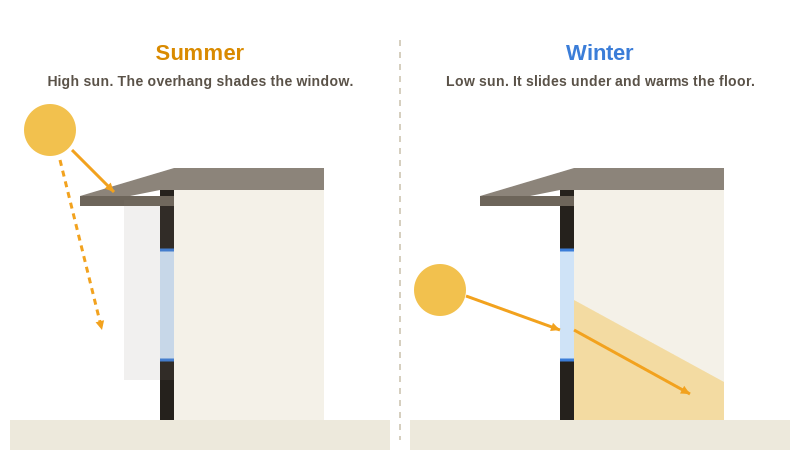
The sun isn't in the same place all year. In summer it's high overhead; in winter it's low. In Georgia the noon sun climbs to about 80° above the horizon in June, almost straight overhead, and only about 33° in December.
Which means a roof overhang above a south window can be sized to block the high summer sun and let the low winter sun in, shade when you want it, heat when you need it, from a piece of roof that doesn't move.
It's an old trick, it costs very little if you plan it in from the start, and it's one of the most satisfying ideas in architecture: a piece of shade that knows what month it is.
Take it into the Designer.
Next, follow along in the Designer, step by step.
Build it → 8 steps in the DesignerDo it in the app
Follow along in the Designer, one step at a time
Open Tiny Architects Designer. This lesson is why the sun control exists.
Draw a simple house with windows on all four sidesWalls › Outside › House OutlineWindows › Single Window👆 Show me
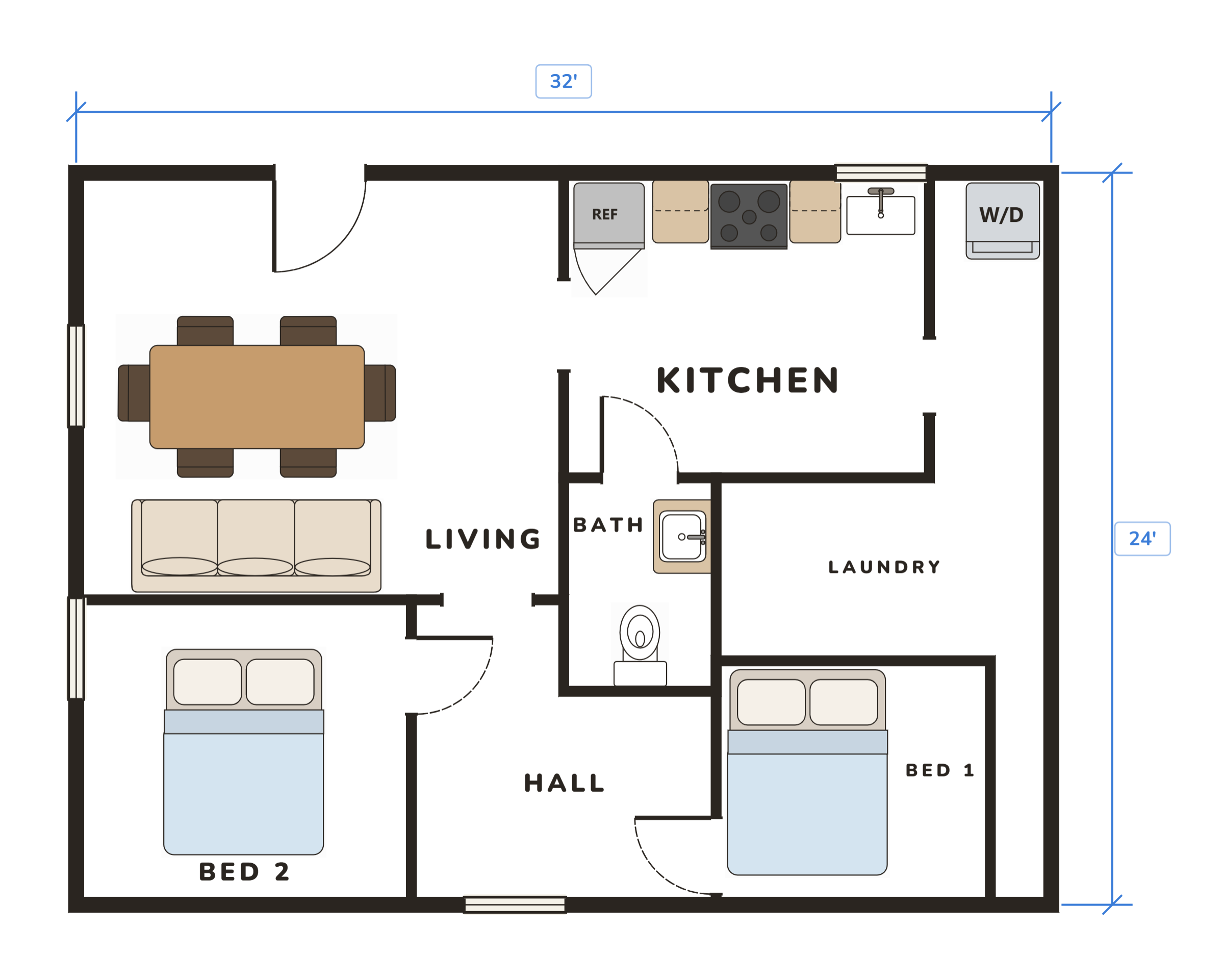
About 30 by 24. Put at least one Single Window in each of the four walls, and make one of them a Double Window so you can see the difference light makes at size.
Go to 3DPlan → 3D👆 Show me
Now find the Sun Position control.
Find north
The sun control is a little sky with N, E, S and W marked round its edge. Note which of your walls faces which way, you're about to change it, and everything depends on it.
Run the day
Step through the presets: Sunrise → Morning → Noon → Afternoon → Sunset → Night. Or press ▶ on the Sunlight Study and let the day play by itself.
Watch the shadows. They're long and pointing one way in the morning, short at noon, then long the other way in the evening. Watch which windows light up and when.
That's a sun study, and it's a real thing architects do on real buildings. You just did one.
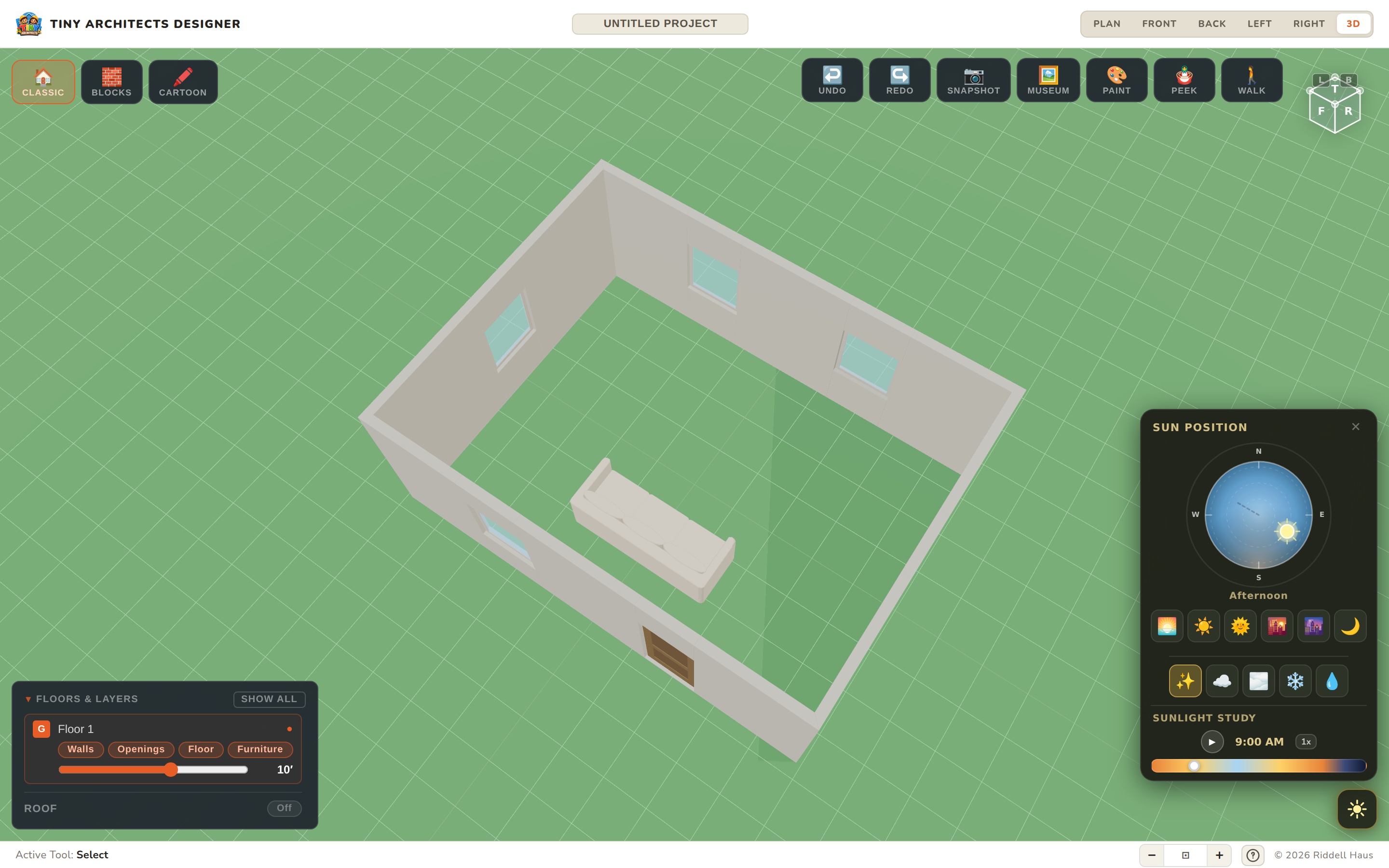
The sun control. The letters round the dome are the compass; the slider at the bottom plays the day. Now the experiment: turn the house
The compass in the app doesn't turn, so turn the house instead. Draw it again beside the first one, a quarter-turn round (24 by 30 instead of 30 by 24), with the same rooms and the same windows, and run the day again.
Same house. Completely different light. The room that was bright at breakfast is now dark until dinner. Nothing about the building changed except which way it points.
Put furniture where the light isLiving Room › Seating › SofaBedroom › Beds › Queen Bed👆 Show me
Drop one of each in, then place them properly:
- Put the bed somewhere that gets morning light, or none.
- Put the sofa where you'd want to sit in the evening.
Run the day again and check you were right. You will be wrong at least once, and being wrong here costs nothing, which is the entire point of drawing before building.
Put a patio in the right placeOutdoor › Patio
Where does it want to go?
Run the day and look at where the house's own shadow falls in the late afternoon. A patio in the shadow of its own house at dinnertime is a patio nobody uses, which is most of what there is to say about outdoor rooms.
Try night
Tap Night, or let the Sunlight Study play on past sunset. The windows stop letting light in and start letting it out. A house at night is a completely different object, and it's worth looking at.
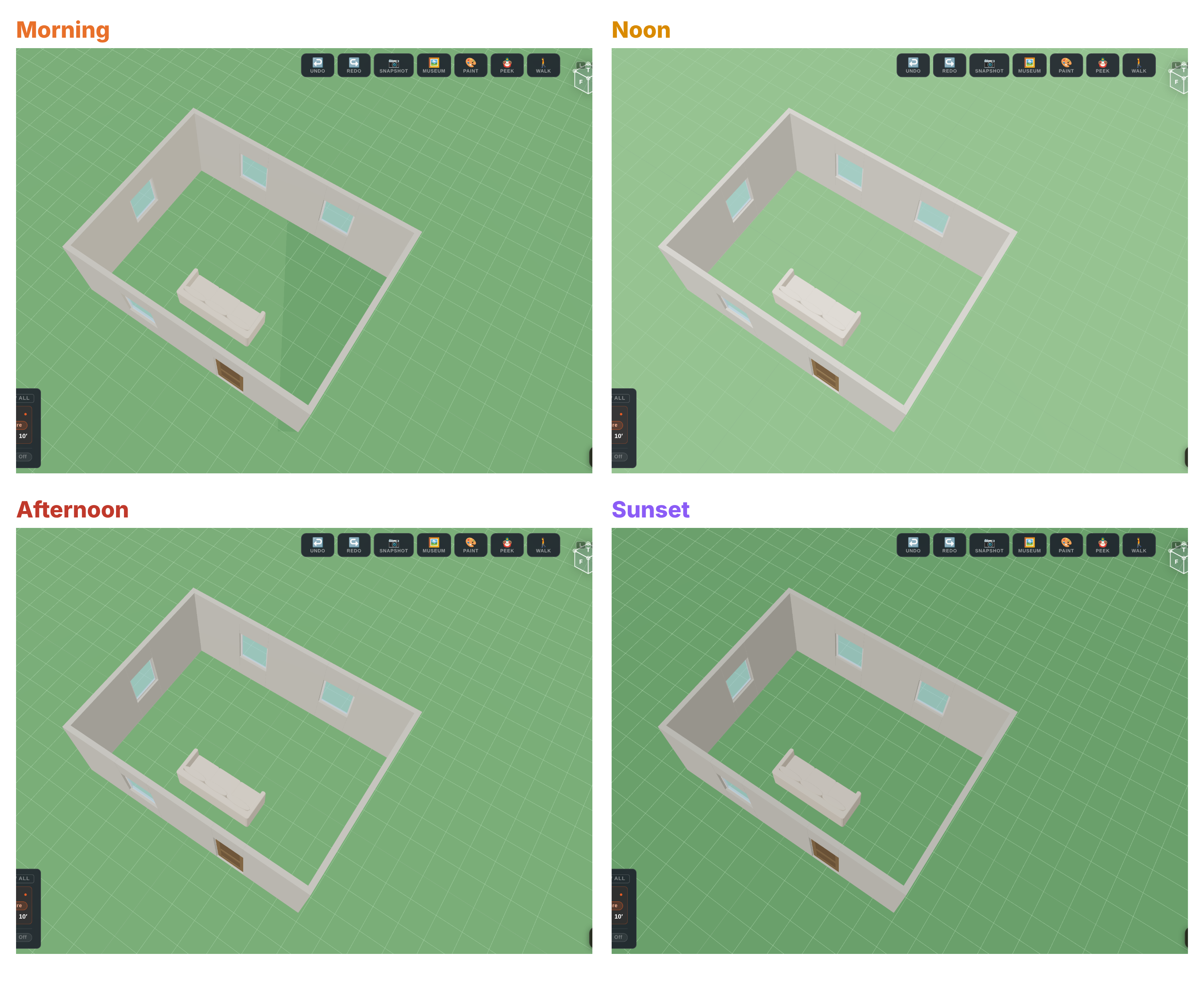
One house, one camera, four times of day. Only the sun moves.
Now make one of your own.
Run a sun study on a house, then rearrange the rooms to suit it
Your turn →Your turn
Now make your own, using what you just learned
Do a sun study on your own home, with no equipment.
Then compare it with what the rooms are actually used for.
- Is your bedroom facing west? Notice how it feels at bedtime in summer.
- Is your kitchen dark in the morning?
- Is there a lovely bright room nobody uses, and a dark one everybody crowds into?
That last one happens a lot, often because the rooms were assigned by size or by plumbing rather than by light.
Then draw your house in the app, try it turned different ways, and find the orientation where the rooms you actually use get the light you actually want.
You can't rotate your house. But you can move what happens inside it, and sometimes that is a genuinely good idea, swapping a bedroom and a study on the strength of nothing but where the sun goes.