How big is a garage, actually?
A single door is 8 or 9 feet wide, a double is 16, and then you need about three feet around the car so the doors can open. Most garages are too small, and now you'll be able to prove it.
Sizing a garage from the car plus door-opening clearance
Size a garage for a real car, then for a real family's stuff
Go and look in a few garages. Count how many have a car in them.
A lot of them don't. There's a car-shaped space full of bicycles, boxes, a freezer, and a lawnmower, and the actual car lives on the driveway.
Some of that is just stuff accumulating. But a surprising amount of it is that the garage was drawn too small in the first place, big enough for a car, not big enough for a car and a person getting out of it.
A garage is a car plus the space to use it
Same method as every other room in this series. Start with what has to fit, add what a person needs, and the room comes out the other end.
Start with the car
Cars vary more than you'd think:
- A small car: about 14 feet long, 6 feet wide.
- A normal sedan: about 16 feet by 6.
- A big SUV or pickup: 18 to 20 feet long, 6½ to 7 feet wide, and taller than you might guess.
That's a range of six feet in length. A garage sized for a small car doesn't fit a truck, and people change cars far more often than they change garages.
Now add the space around it
Here's the part that gets skipped:
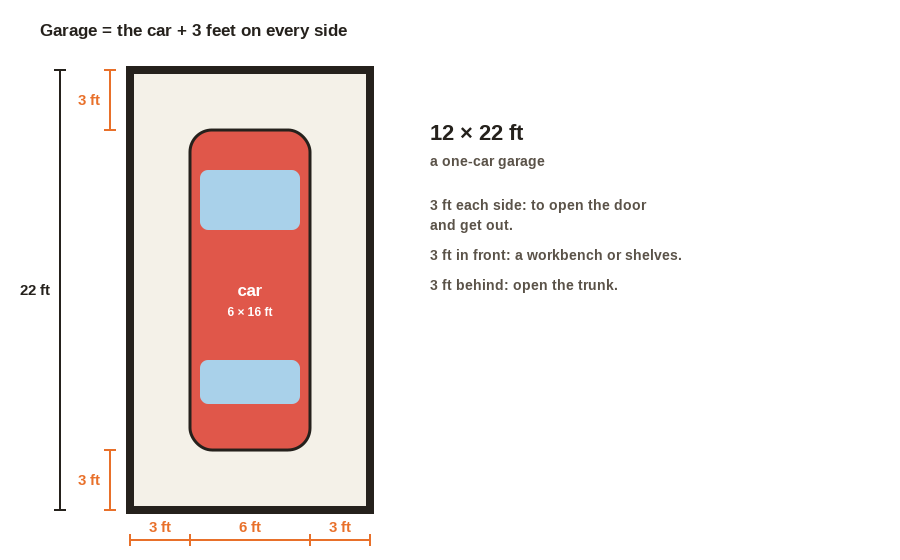
- About 3 feet on each side. Not to walk past, to open the car door and get out. A car door swings a long way, and this is the number people most often lose.
- About 3 feet at the front, for a workbench, shelves, or just not scraping the wall.
- About 3 feet behind, to open the trunk and walk around.
Add it up for a normal sedan:
- Width: 3 + 6 + 3 = 12 feet.
- Length: 3 + 16 + 3 = 22 feet.
A garage is the car plus about 3 feet on every side, enough to open the doors and get out. For a normal sedan that lands at about 12 by 22 feet for one car.
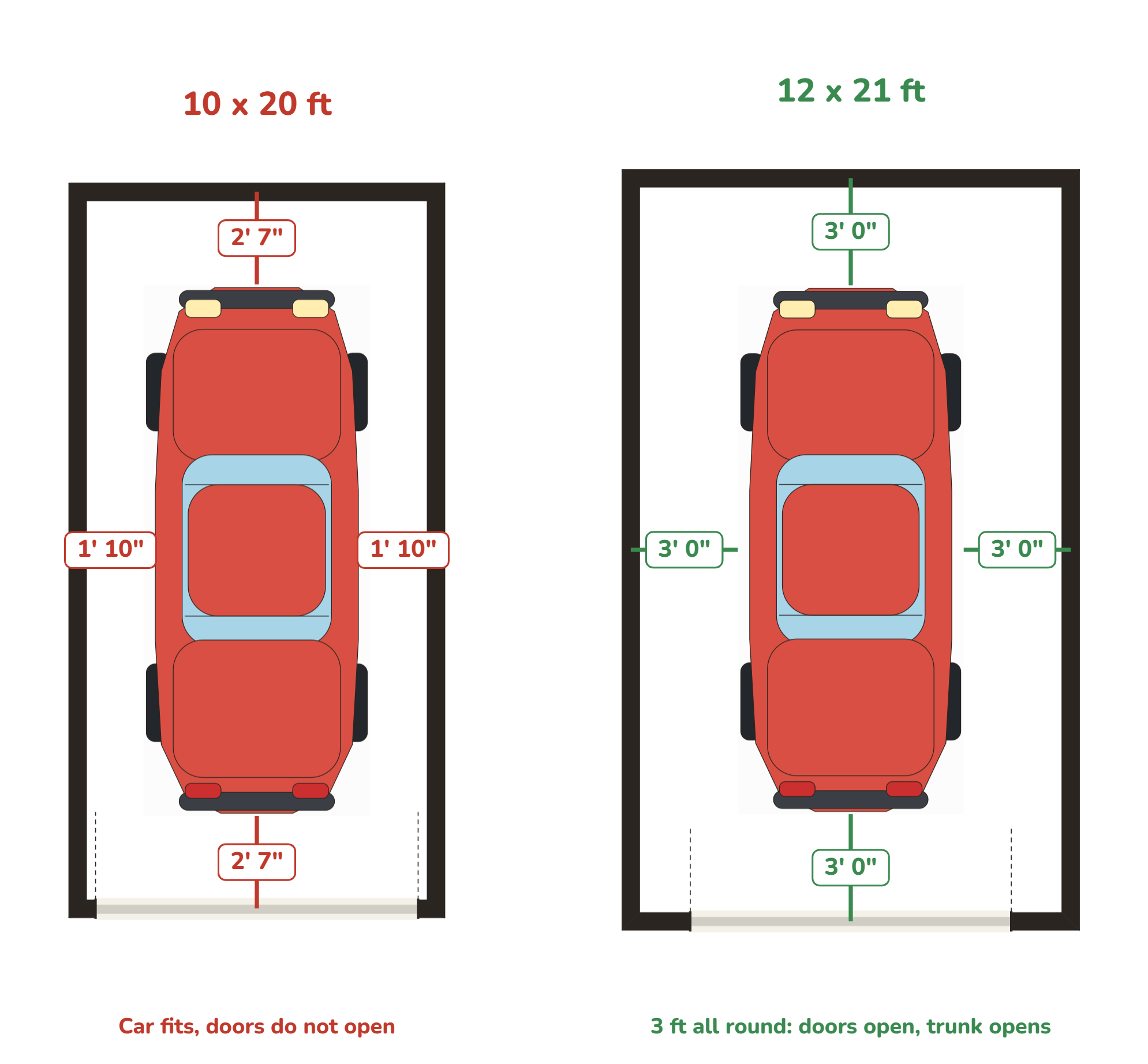
A one-car garage wants to be about 12 by 22 feet. Some real ones, especially older ones, are as small as 10 by 20, which fits the car and not much else, and that's the garage with the bikes in it.
For two cars: two 6-foot cars plus 3 feet on each outside edge plus 3 feet between them so both doors can open.
- Width: 3 + 6 + 3 + 6 + 3 = 21 feet, and 24 is much better.
- Length: still about 22 feet.
The doors, which are the numbers people actually quote
Garage doors come in standard sizes, like everything else:
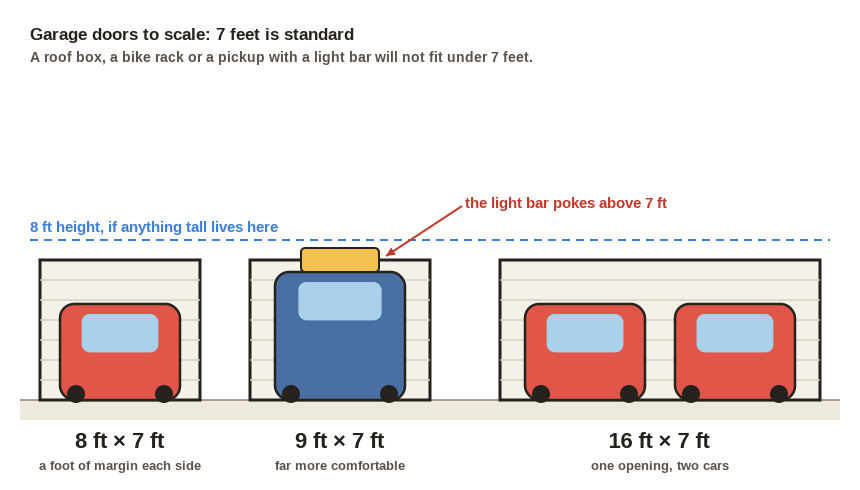
- Single door: 8 or 9 feet wide. Nine is far more comfortable, with an 8-foot door you're aiming a 6-foot car through with a foot of margin on each side, and the wing mirrors know it.
- Double door: 16 feet wide. One opening for two cars.
- Two singles side by side is the other option: more wall between them, which is structurally easier and looks less like a hangar, at the cost of more careful aiming.
- Height: 7 feet standard, and 8 feet if anything tall lives there. This is the one that catches people out, a roof box, a bike rack, or a pickup with a light bar will not fit under 7 feet.
And the thing that decides where it goes
A garage has a hard requirement, like the dryer: it must touch a driveway, and the driveway must reach the street.
That single fact usually decides which side of the house the garage is on before anything else is drawn. A driveway needs about 10 feet of width for one car, and it needs room to turn in from the road.
Take it into the Designer.
Next, follow along in the Designer, step by step.
Build it → 8 steps in the DesignerDo it in the app
Follow along in the Designer, one step at a time
Open Tiny Architects Designer. There is a real car in here, and a real garage door, so you can build this exactly rather than imagining it.
Get the car out and look at itOther › Garage › CarMeasure › Custom Measure
Dropped anywhere on the empty canvas. Now measure it with , across it and then down it.
6 feet 4 inches wide. 14 feet 10 inches long. That is an ordinary car, not a big one, and it is already almost fifteen feet of building.
Draw a small garage around itWalls › Outside › House Outline👆 Show me
Dragged to 20 feet by 10, about as small as real garages get, and you'll still find them on some older houses. Drag the car inside it and center it up.
Measure what's left
Custom Measure from the side of the car to the wall it faces, then from its nose to the wall in front. Click the car and the point sticks to its edge.
- Sides: about 1 foot 10 inches. Each.
- Front and back: about 2 feet 7 inches.
Not three feet. Not two feet. And the measuring tool reads to the middle of the wall, so the real gap is a few inches less than that. Open a car door in under two feet, go and try it against a real wall, right now, with a tape measure. You get out sideways, and if you live in that house you do it every day for years.
Now draw it properly
Redraw the box at 12 feet by 22. Re-measure: about 2 feet 10 at the sides and 3 feet 7 front and back. That's a door you can open, a person who can walk round the front, and it cost you two feet of building in each direction.
Put the door onDoors › Garage › Garage Door
Clicked on the short wall. Measure it: 9 feet wide. Now measure your car again, 6 feet 4. The door is only 2 feet 8 inches wider than the car, and that gap is split between two mirrors and whoever is steering.
Flip to 3D and look at it. The door is 7 feet tall, which is why a roof box or a tall van is a real problem and not a small one.
Do the two-car version
Draw 24 by 22 and put a second Car in beside the first. Measure the gap between them, and the gap from each car to its own wall.
You want 3 feet between the cars. If you have less, one of those doors is being opened by someone who has to breathe in.
Add the drivewayOutdoor › Ground › Driveway👆 Show me
Drawn from the garage door out toward where a street would be. Measure its width, about 10 feet per car, and look at how much of the yard it just ate. A driveway is often the biggest single paved thing on a house's land, and it's easy to forget to draw it.
Now add the real stuff
Along one wall, mark out a 2-foot-deep strip for shelves and bikes. Where did it come from? Your 3-foot side clearance.
That's the story of a lot of full garages, the storage arrived, the clearance left, and the car moved outside.
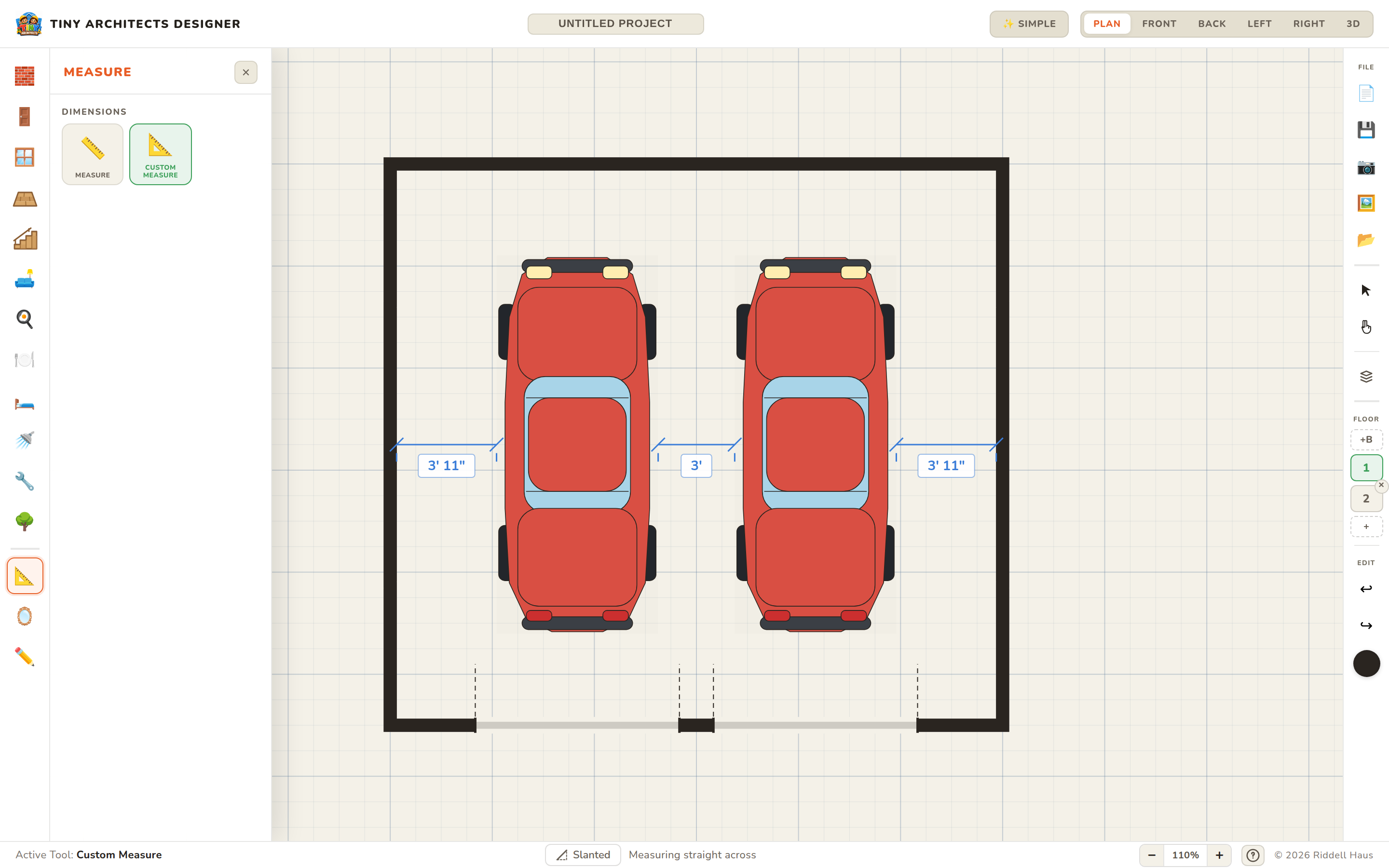
Three feet between the cars. Both drivers can get out.
Now make one of your own.
Size a garage for a real car, then for a real family's stuff
Your turn →Your turn
Now make your own, using what you just learned
Measure a real garage and find out whether it works.
Then the diagnosis. If the garage is full of stuff and the car is outside, work out which happened first, was it always too small, or did the stuff take the clearance?
Then design the fix in the app. Often it's not a bigger garage, it's a 2-foot-deep storage wall built into the plan from the start, with the car space sized after that. Which is exactly how a designer would have avoided the problem in the first place: plan for the stuff, because the stuff is coming.