
Where a rug is supposed to stop
A rug that's too small makes a room look smaller, and under a dining table it makes every chair tip. There are two numbers: 24 inches past the table, and about a foot short of the wall.
Rug sizing, 24 inches past the table, 12 to 18 inches off the wall
Mark out the right rug for a dining table, in measurements
You have probably sat in a chair that tipped.
Not dramatically, just that sudden wobble as you push back from the table and one back leg drops off the edge of the rug. Everyone steadies themselves and carries on, and nobody ever says the actual problem out loud.
The rug is the wrong size.
Not the wrong color, not the wrong pattern. The wrong size, by a number somebody could have looked up.
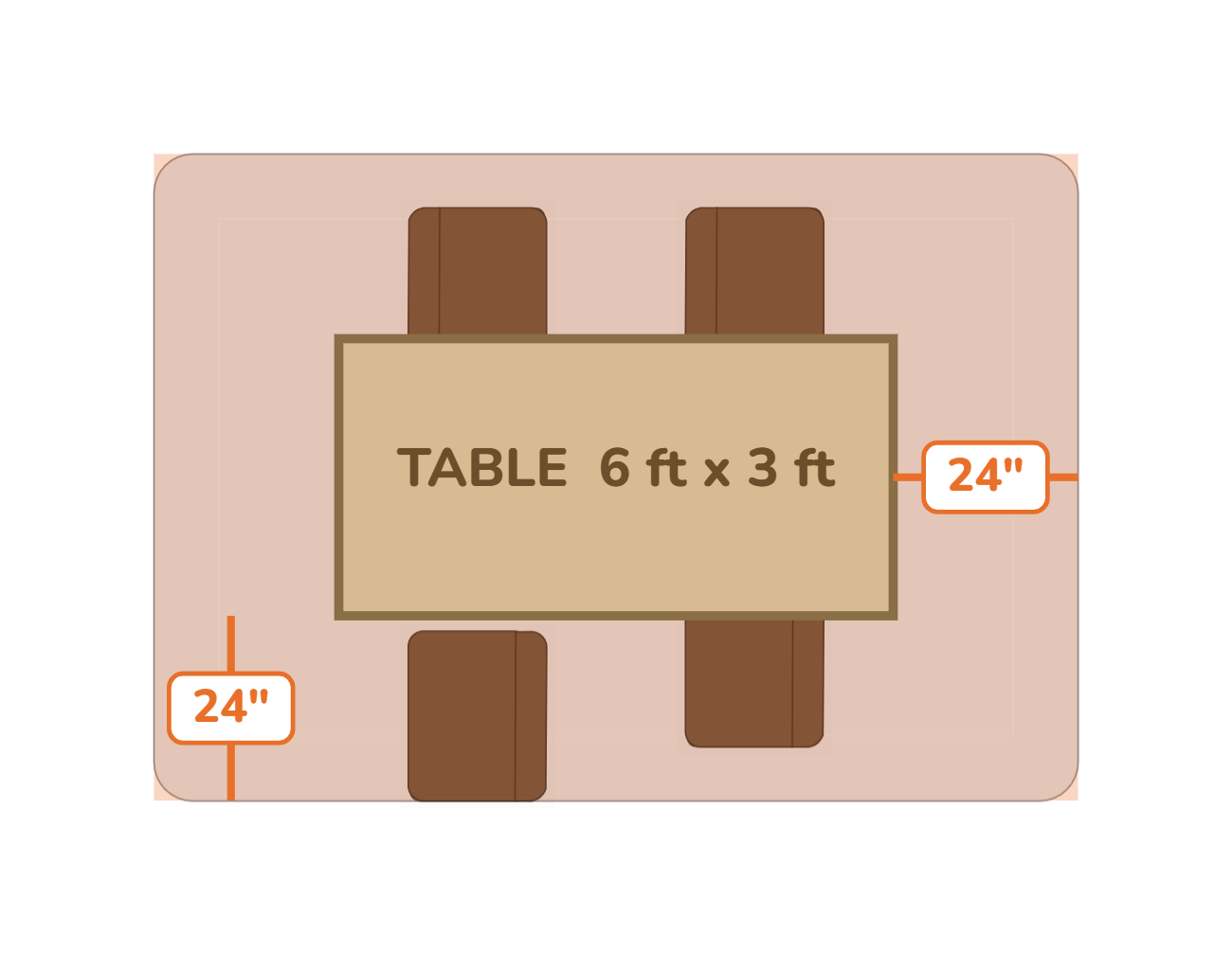
A rug is furniture, and it has dimensions
People buy rugs the way they buy posters, by how they look. Designers size them the way they size everything else: from what has to happen on top of them.
Two rules of thumb cover most of it.
Rule one: 24 inches past the table
Under a dining table, the rug has to be big enough that a chair stays entirely on it when pulled out.
When someone stands up, the chair slides back until its back legs are roughly two feet out from the table edge. Those back legs need to stay on the rug, which gives you the number:
The rug should extend at least 24 inches past every edge of the table. Thirty is better.
That's less than the 32 inches of floor it takes to get out of a chair, and both numbers are right. The 24 is how far the chair's legs travel. The 32 is the legs plus the chair's back and the person standing up behind it. The rug only has to be under the legs.
Do the arithmetic on a 6-foot by 3-foot table: add 24 inches on all four sides and you need a rug 10 feet by 7. Which is much bigger than most people expect, and one reason so many dining rugs end up too small, the rug looks generous in the store, sitting next to nothing.
Under a round table the same rule gives a round rug about four feet wider than the table all told. A 4-foot table wants an 8-foot rug.
Rule two: stop about a foot short of the wall
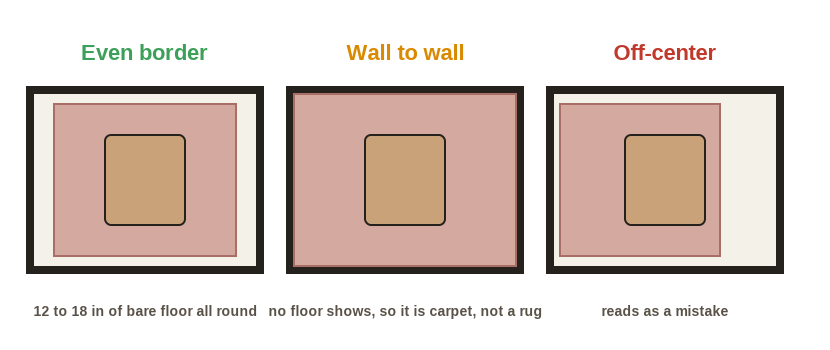
In any room, a rug should stop before it reaches the walls, leaving a border of bare floor showing all the way around:
Leave about 12 to 18 inches of floor between the rug and the wall.
Twelve in a small room, eighteen in a big one. What matters is that it's even on all sides, an off-center border can read as a mistake even to people who couldn't tell you why.
The border is doing real work. It frames the rug, it shows off the floor you paid for, and, the useful part, a room with a visible border of floor around the rug tends to look bigger, because your eye can follow the floor all the way to the walls.
When the two rules disagree
Sometimes they collide. Your table needs 24 inches of rug all round; your room only leaves 8 inches of border after that.
When that happens, the table wins. A chair tipping off a rug is a real problem several times a day. A slightly tight border is something a visitor might vaguely notice once.
Take it into the Designer.
Next, follow along in the Designer, step by step.
Build it → 8 steps in the DesignerDo it in the app
Follow along in the Designer, one step at a time
Open Tiny Architects Designer. You are going to draw a rug, measure a table, and find out the two don't get along.
Set up the room and the tableWalls › Outside › House Outline👆 Show me
About 12 by 9 feet. Then Dining Room → Tables → Rectangle Table, dropped in the middle.
Look at the chairs👆 Show me
The table comes with six chairs already tucked in. They matter here: the rule isn't about the table, it's about where the chair legs end up when somebody pushes back to stand.
Measure the tableMeasure › Custom Measure
Along one long side and one end of the wooden top. The measuring tool likes to snap to the outside of the whole piece, chairs and all, so zoom in and click right on the top's edge. You should get about 84 inches and 41 inches, a 7-foot table that seats about eight. That's a proper dining table, which is going to matter in a moment.
Work out the rug before you draw it
Add 24 inches at each end of each measurement, 48 inches total on each one.
- 84 + 48 = 132 inches, or 11 feet.
- 41 + 48 = 89 inches, or about 7 feet 5.
Rugs are mostly sold in a handful of standard sizes, and the smallest common one that covers 11 by 7½ is 9 by 12 — an 8 by 10 is a foot too short.
Now draw it and watch it failFloors › Rug
Then drag a 9 by 12 rectangle over the table, long way along the table. Every grid square is one foot, so you can count: 12 squares one way, 9 the other.
Look where the edges end up: into the walls. The app lets you draw it, but your room is 12 by 9 on the wall lines, the floor inside is a few inches smaller, and the rug is 12 by 9 itself. A real one would have to curl up the walls.
That is not a mistake in your arithmetic. It's the finding. The table is too big for the room, and the rug is what made it obvious, which happens in a lot of real dining rooms too.
Fix it and draw again
Grow the room to about 15 by 12, then draw the rug again. Now measure the bare floor from the rug's edge to each wall. You should find about 15 inches all the way round, inside rule two's 12 to 18. That is what 15 by 12 buys you (the walls take a few inches of it), and why a 12-foot rug needs more than a 12-foot room.
See what a rug is notFloors › Carpet
Click inside the room. It fills wall to wall, corner to corner, no border, no edge, nothing to define. Undo it (Ctrl+Z) and you're back to your rug with its ring of bare floor around it.
That difference between the two pictures is the whole of rule two.
Test rule one for real
The chairs are part of the table piece, so they don't drag, measure instead. From the edge of the wooden top, run Custom Measure 24 inches straight out: that's about where a chair's back legs land when somebody stands up. Is the end of that line still on the rug? If it falls off the edge, your rug is too small, and now you can see it instead of taking somebody's word for it.
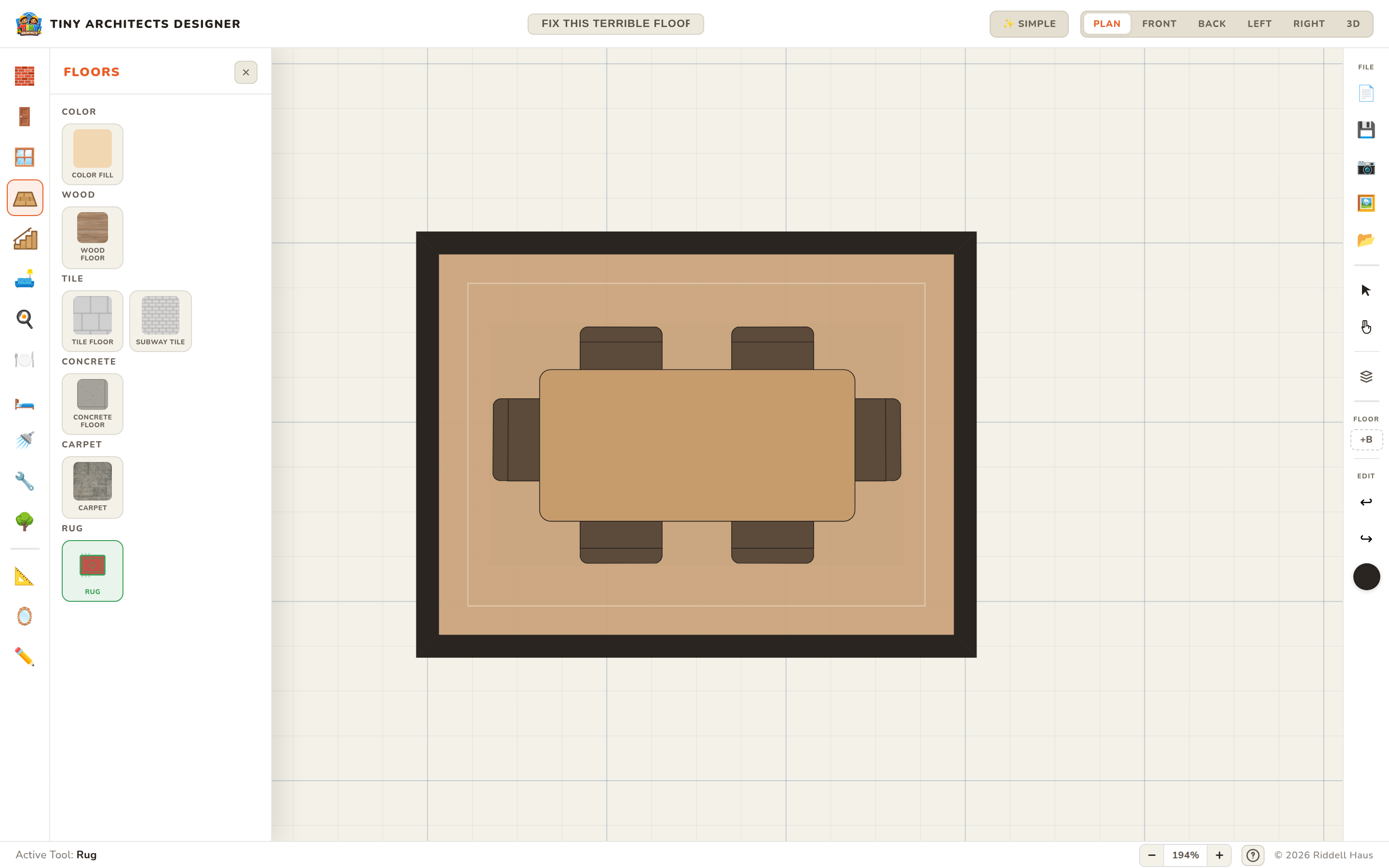
The rug the table needs, in the room the table is in.
Now make one of your own.
Mark out the right rug for a dining table, in measurements
Your turn →Your turn
Now make your own, using what you just learned
Measure the rug in your own house and find out if it's right.
Lots of rugs fail at least one of these, including expensive ones. When you find one that fails, work out what the right size would have been and write that number down. That single number would have been worth more than any amount of looking at patterns.